What Is a Board Foot?
A board foot is the standard volume unit for hardwood lumber in North America: a piece of wood 1 inch thick × 12 inches wide × 12 inches long — 144 cubic inches, figured on nominal dimensions. You'll see it abbreviated BF, bd ft or FBM (foot, board measure).
The board foot formula, worked
Take the most-bought board in America, a 2×4 that's 8 feet long: 2 × 4 × 8 ÷ 12 = 5.33 board feet. A 1×6×8 works out to exactly 4 bf; a chunky 8/4 walnut board 7″ wide and 8′ long is 2 × 7 × 8 ÷ 12 = 9.33 bf. Once you can run this in your head at the rack, a hardwood price list stops being a foreign language — or skip the mental math and use the board foot calculator, which tallies whole cut lists with prices.
Why lumber is sold this way
Hardwood comes off the sawmill in random widths and random lengths — nature doesn't grow 6-inch-wide trees. Pricing by the piece would be chaos, and pricing by length alone ignores how much wood you're actually getting. Volume is the only fair meter, and the board foot is simply a friendlier way to say "a twelfth of a cubic foot." Dimensional softwood at the big-box store (2×4s, 2×6s) is priced by the piece instead, but its board footage still matters for framing estimates and comparing costs — see the printable chart for every common size.
4/4, 5/4, 8/4 — the quarter system
Hardwood dealers quote thickness in quarters of an inch, read aloud as "four-quarter", "five-quarter", "eight-quarter":
- 4/4 = 1″ rough — the workhorse for furniture parts and shelving
- 5/4 = 1¼″ — stair treads, thicker table aprons
- 6/4 = 1½″ — chair parts, small legs
- 8/4 = 2″ — table legs, workbench tops, turning stock
- 12/4 = 3″ and 16/4 = 4″ — big slabs and heavy legs
The quarter size refers to the rough-sawn thickness. After the yard surfaces two faces (S2S), your 4/4 board arrives around 13/16″ — but you still pay for the full 4/4, because the tally was made before the planer got involved. That's not a scam; it's how every mill in the country has done it for a century.
Nominal vs actual — the rule that trips everyone
Board feet are always figured on nominal dimensions. A surfaced 2×4 truly measures 1½″ × 3½″, yet it tallies as a full 2″ × 4″. Same for hardwood: the 4/4 board that's 13/16″ after planing still counts as 1″. Nominal is the convention on the price sticker, the invoice and every calculator on this site — if you ever need the real fiber volume for engineering, measure actual and use inches ÷ 144.
Board foot vs linear foot vs square foot
- Linear (lineal) foot measures length only — meaningless without a cross-section. Convert BF ↔ LF.
- Square foot measures area — flooring and sheet goods territory. At 1″ thick, 1 bf covers exactly 1 ft². Convert BF ↔ ft².
- MBF = 1,000 board feet, the wholesale unit sawmills and brokers trade in. MBF calculator.
- Cord = 128 ft³ of stacked firewood — a volume unit too, but for burning, not building. Cord calculator.
A short history
The board foot grew out of 19th-century New England sawmill practice, when "board measure" standardized how mills billed rough one-inch boards. The related log rules — Doyle (1825), Scribner (1846) and International ¼″ (1906) — extended the same unit backward to standing timber, estimating how many board feet a log would surrender to the saw. The unit survives because it works: every hardwood price list in North America still reads in dollars per board foot.
Definitions per USDA Forest Products Laboratory, Wood Handbook; log-rule history per state forestry extension literature.
FAQ
How many board feet in a 2x4x8?
5.33 board feet: 2 × 4 × 8 ÷ 12. All common framing sizes are on the chart.
How many board feet in a cubic foot?
Exactly 12 — a board foot is 1/12 of a cubic foot.
Do I pay for rough or surfaced thickness?
Rough. Surfacing removes wood but not from your bill: 4/4 stock planed to 13/16″ still tallies and prices as 1″.
Board foot cheat sheet
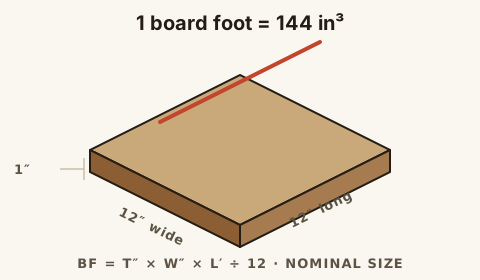
- 1 board foot = 144 in³ = 1/12 ft³ · 12 bf per cubic foot
- 2×6 and 1×12: board feet = length in feet · 2×4: two-thirds of length
- 1 bf of 4/4 covers 1 ft²; halve the coverage for 8/4
- Nominal sizing is codified in the American Softwood Lumber Standard (NIST PS 20); species data in the USDA Wood Handbook